
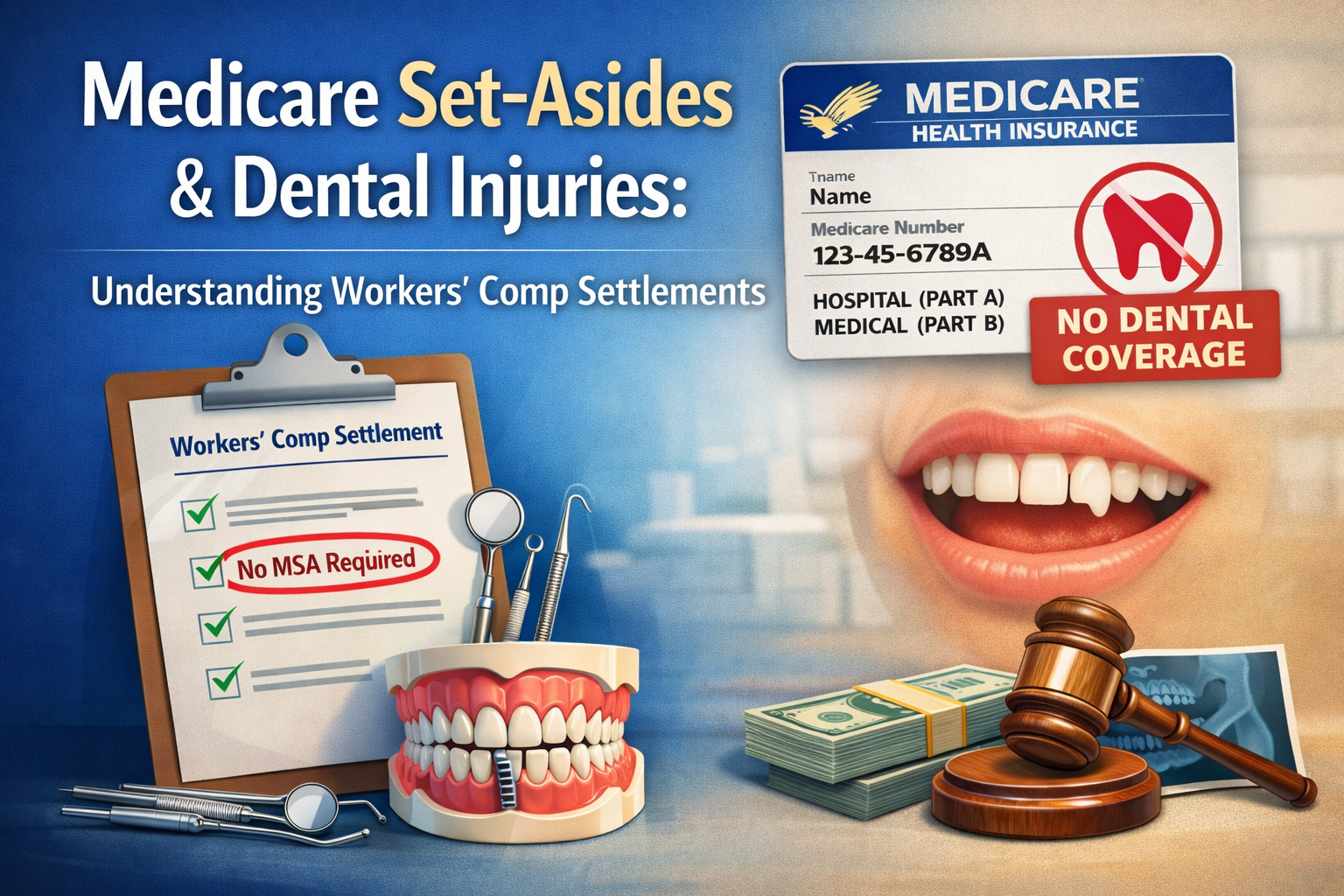
Medicare Set-Asides and Dental Injuries: What You Need to Know
When settling a California workers’ compensation case involving a Medicare-entitled injured worker, one of the most critical considerations is whether a Workers’ Compensation Medicare Set-Aside Arrangement (WCMSA) is required.
But what happens when the injury involves the mouth and teeth? Can a Medicare Set-Aside be established for dental treatment?
The short answer is no—and understanding why is essential for properly structuring your settlement.
Understanding Medicare Set-Asides
A Medicare Set-Aside (MSA) is a financial arrangement that allocates a portion of a workers’ compensation settlement to pay for future medical services related to a work injury that Medicare would otherwise cover. Its purpose is to protect Medicare’s interests by ensuring settlement funds are used before Medicare becomes the primary payer.
According to CMS regulations, MSA funds may only be used to pay for medical services and prescription drug expenses that Medicare would normally cover. A “Medicare-covered expense” is defined as:
“Services for which Medicare benefits are payable or would be payable except for applicable Medicare deductible and coinsurance provisions.”— SOC § 14.83
The Dental Care Exclusion
Here’s the critical issue: Medicare does not cover routine dental care.
The CMS Workers’ Compensation Medicare Set-Aside Arrangement Reference Guide explicitly lists routine dental care among services Medicare does not pay for, including:
-
Acupuncture
-
Eyeglasses
-
Hearing aids
SOC § 14.83
Because Medicare does not cover these services, they cannot be paid from an MSA account. This creates a unique situation in workers’ compensation cases involving dental injuries.
Practical Implications for Dental Injury Cases
When a Medicare-entitled injured worker’s injury is limited to the mouth and teeth, several important considerations arise.
1. No MSA Required
Since Medicare does not cover dental services, there are no Medicare-covered future medical expenses to protect. As a result:
-
No MSA needs to be established
-
No CMS submission is required
-
Administrative costs and ongoing MSA management are avoided
2. Settlement Structure
Although no MSA is required, the settlement can still account for future dental care:
-
Dental treatment costs are included as part of the standard workers’ compensation settlement
-
Funds remain outside of any MSA framework
-
The injured worker retains greater flexibility in using the funds
3. Medicare’s Interests Are Not Affected
Because Medicare would never be responsible for paying for work-related dental treatment, Medicare’s interests are not implicated.
Under 42 CFR § 411.54(a), there is no need to protect Medicare from future payment obligations that would never arise.
An Important Exception to Consider
While routine dental care is excluded from Medicare coverage, there is one theoretical consideration:
If a settlement provides funds for items or services that are not currently covered by Medicare but later become covered, those funds should then be treated as part of a set-aside arrangement. — SOC § 14.83
That said, this remains largely theoretical. Routine dental care has historically been excluded from Medicare coverage, and there is no indication this will change in the foreseeable future. Still, it is worth noting in settlement documentation.
What About Oral Surgery?
Some practitioners ask whether oral surgery related to jaw injuries or facial trauma might be Medicare-covered.
Medicare does cover certain oral surgical procedures in very limited circumstances, such as:
-
Jaw reconstruction following traumatic injury
-
Treatment related to cancer or other covered medical conditions
These situations are rare and highly specific. If your case involves complex oral or maxillofacial surgery:
-
Carefully review Medicare’s coverage guidelines
-
Consider consulting an MSA professional
-
Clearly document why procedures are or are not Medicare-covered
Best Practices for Dental Injury Settlements
When settling a dental injury case involving a Medicare-entitled injured worker, consider the following best practices.
1. Document the Nature of the Injury
Clearly establish that the injury is limited to dental or oral treatment not covered by Medicare.
2. Explain Why No MSA Is Necessary
Include settlement language explaining that no MSA is required because future care involves non-covered dental treatment.
3. Allocate Funds Appropriately
Ensure the settlement provides adequate compensation for future dental care, separate from any MSA considerations.
4. Consider State Law Requirements
Even if Medicare does not require an MSA, California workers’ compensation law still applies, including settlement of future medical treatment under LC § 5000 et seq.
5. Protect Your Client
Make sure the injured worker understands:
-
Medicare will not cover their work-related dental treatment
-
Settlement funds allocated for dental care should be used accordingly
-
Maintaining records of dental expenses is important
The Bottom Line
When a Medicare-entitled injured worker’s injury is limited to the mouth and teeth, the takeaway is clear:
No Medicare Set-Aside is required.
Because Medicare does not cover routine dental care, there are no Medicare-covered future medical expenses to protect, and Medicare’s interests are not implicated. This simplifies settlement, reduces costs, and eliminates the administrative burden of MSA management.
That said, proper documentation and thoughtful settlement structure remain essential to ensure the injured worker’s future dental needs are adequately addressed.
This blog post is for informational purposes only and does not constitute legal advice. For guidance on a specific workers’ compensation matter, consult a qualified attorney or Medicare Set-Aside professional.